



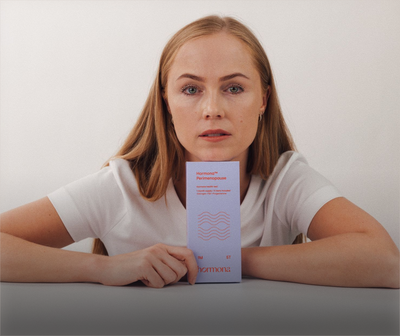


Hormona™ perimenopause test
Explore your
perimenopause stage
Periods shifting, poor sleep, not feeling quite yourself? Hormona's at home perimenopause test tracks estrogen, progesterone and FSH with a simple urine test, so you can see your perimenopause stage and how your hormones change over time.
- Painless at-home urine tests, just 5 mornings a month
- A schedule that adapts, even if your periods are irregular
- Quantitative results, not just high or low
- Unlock your perimenopause stage after 3 months
Not sure which plan? Find your fit.
*Hormona helps you track hormone levels and symptoms.
It does not diagnose hormonal imbalances or medical conditions.


Estrogen


Progesterone


FSH


Helping you navigate each perimenopause stage
Find out which of the perimenopause stages you are in, and see which perimenopause symptoms connect to your FSH, estrogen and progesterone levels with an at home FSH test.

Early Perimenopause
Early perimenopause brings irregular cycles and more sporadic ovulation. Spotting and heavier periods may occur, with fatigue, anxiety and brain fog common symptoms.

Late Perimenopause
Late perimenopause brings significant hormone fluctuations, unpredictable cycles and often absent ovulation. Hot flashes and night sweats are common symptoms.

Menopause
Menopause confirms the final menstrual period has occurred. Hot flashes, night sweats and heart palpitations can persist as hormone levels fluctuate before eventually settling.


The 3 hormones running the show
Hot flashes, sleep, mood, your period. Meet the hormones your perimenopause hormone test tracks as they shift through perimenopause.
-
ESTROGEN
Brain fog, skin and vaginal dryness.
Naturally decreases as we age, which can show up as lower energy, hot flashes, and night sweats. However, during late perimenopause, it can sharply increase during the second half of the cycle, occasionally causing heavy bleeding.
CAN RELATE TO
- Low energy
- Memory loss
- Hair loss
- Hot flashes
- Low sex drive
- Night sweats
-
PROGESTERONE
Sleep, mood and heavier periods
During perimenopause, cycling women may see early changes tied to heavier flow, irregular cycles and lower bone mineral density. If you've stopped cycling, expect consistently low baseline levels.
CAN RELATE TO
- Period changes
- Insomnia
- Weight changes
- Mood changes
-
FOLLICLE-STIMULATING HORMONE (FSH)
Rise with age, reflecting fewer remaining ovarian follicles
Helps kickstart each cycle. Higher levels often point to natural changes from aging and ovaries that are less responsive. Tracking it over time can show shifts around your cycle.
CAN RELATE TO
- Hot flashes or night sweats
- Cycle length changes
4 steps. 15 minutes. Zero needles.
Test from your bathroom with a highly personalized schedule that adapts to your cycle, even if your period is missed or absent for months. The Hormona app tells you when to test and walks you through every step.
-

STEP 1
Order your kit and download the app.
Each kit tests for Estrogen, Progesterone, and FSH. Activate it in the Hormona app.
-

STEP 2
The app tells you when to test
A personalized schedule tells you when and which hormone to test.
-

STEP 3
Dip, then wait 15 minutes
Use your first morning urine. The app times the wait, so you can get on with your morning.
-

STEP 4
Scan with your phone
Hold the strip in good light and the app reads it. Your result appears right away.


More than a number
Every result tells you what it means for you, and what you can try next.
-
Your level, in context
Quantitative results, compared against reproductive ranges to understand the shift.
-
What it means for you
After 3 month testing, see your hormone trends and likely perimenopause stage, with a report to share with your doctor.
-
Evidence-based education
In-depth materials on what to expect during perimenopause, nutrition guidance, hormonal and non-hormonal treatment options and symptom support.
Three months, six, or a whole year?
Three months show where you are. Six show what's shifting. Twelve show how you're changing over time.
-
ASSESS • 3 MONTHS
Your starting point
Best if you're noticing changes and want to know where you stand.
- 15 tests across 3 months
- Your results in plain language
- Your personalized report, ready to share with your doctor.
3 363 kr
-
NAVIGATE • 6 MONTHS
Track what's changing
Best if you're trying new lifestyle changes, like changes to your diet, exercise or sleep, and want to see how your hormones respond.
- 30 tests across 6 months
- Everything in assess
- Compare your levels before and after a change
5 793 kr
-
SUPPORT • 12 MONTHS
Change over a year
Best if you want to follow how your hormones are changing throughout perimenopause over the long term.
- 60 tests across 12 months
- Everything in navigate
- Spot long-term trends as your body changes
9 844 kr
Your hormones rise and fall.
Hormona follows them.
A blood test captures one moment. Testing on key days, over several months, shows how your levels naturally move and what’s normal for you.

Beyond a single day
In perimenopause, your hormones can shift from one cycle to the next. That’s why we test on key days across your whole cycle, not a single snapshot. The app plans your test days around your own rhythm, even when your cycle is irregular.
Capture your trend line
Testing over three months or more captures your own pattern and what’s normal for you.
Notice when things shift
Tracking over time helps you see changes as they happen, like when your cycle starts to change, during a stressful time or as you move through perimenopause.
HORMONA UNIQUENESS
Why Our At Home Perimenopause Test Is Different
Understand your hormones instantly. No blood tests. No labs. Just the latest advances in science and technology.
| Hormona | Other urine trackers | Saliva testing | Blood test | |
|---|---|---|---|---|
| Sampling method | Urine Stable | Urine Stable | Saliva Volatile | Finger-prick Painful / Messy |
| Quantitative accuracy | Across the clinical range | At thresholds | At thresholds | Across the clinical range |
| Analysis method | iOS / Android | Extra device | iOS | Lab |
| Test from anywhere, globally | ||||
| For every life stage | ||||
| Real-time results | 3-5 days |


The Science behind our perimenopause testing kits.
Take your first step towards understanding your hormones.
99%
of women report that hormones have a significant impact on their mood.
68%
of women say that they don't know the signs of menopause.
87%
of women say they often feel fatigued.
* Statistics from the Hormona app.
Science-Backed Hormone Insights
Nanoshell technology
Advanced nanoshell technology that can fully quantify your hormone levels.
Stage-specific mapping
Track hormone patterns over time and discover your perimenopause stage.
Backed by experts
All the tools to analyze your hormones at home, backed by women’s health experts.
Who it’s for
Suitable for women 40+ who want to better understand their perimenopause journey.
Thousands of women.
Millions of data points.
We never have and never will share your individual health data.
Wherever you are, your data is protected under GDPR, one of the world's strictest privacy laws.
- 5.9m symptoms logged
- 435k total cycles
- 191 countries using Hormona
”I used these tests for 3 consecutive months and found it very straightforward. The app is easy to use & informative.”
“These tests are great to help you understand where are you on your menopause stage. They are easy to do, easy to follow the instructions and the app is super helpful and gives you a lot of information.”
“Really easy to use and great insights from the app throughout your cycle.”
Common Questions About At Home Perimenopause Testing
What can hormone testing tell me?
It can show you if your body is undergoing expected changes due to aging, diet, or exercise. Testing also helps you understand the symptoms you may be experiencing, though it is important to remember that not all symptoms are directly related to ovarian hormone levels.
How often should I test my hormones?
It depends entirely on your specific goals. For example, if you plan to change your diet and want to check its impact, it is best to test for at least one month before making the change. You should then continue testing for 3 to 5 months, as the first few months are an adjustment period before more lasting, prominent changes appear. Ideally, you want to see how your body responds 3 to 6 months after an intervention and track your trends over a full year.
How do I prepare for a Hormona urine test?
Maintain your normal hydration routine during the day, but avoid drinking fluids for 1 to 2 hours before going to bed. Limiting evening fluids helps you avoid waking up to use the bathroom at night. You should also abstain from alcohol and foods that can alter the color of your urine. Collect your first morning urine in a container immediately upon waking and test without a delay.
Which hormones does the Hormona Perimenopause test kit measure?
The Hormona Perimenopause kit contains two FSH tests to measure follicle-stimulating hormone, two Estrogen tests to measure estrone-3-glucuronide (the main estradiol metabolite in urine), and one Progesterone test to measure pregnanediol glucuronide in urine.
How accurate is the at home perimenopause test?
Our urine results strongly correlate with blood levels and reflect the same hormonal shifts happening in your body. However, because we measure excreted metabolites in urine rather than direct blood levels, urine results serve as a proxy for how hormones affect your cells and tissues. Please note that results can be influenced by your hydration levels or if you have an underlying liver or kidney condition.
Do I need a prescription to use the Hormona Perimenopause test at home?
No. You do not need a prescription or a doctor's note to use the Hormona at home perimenopause test.
What is the typical perimenopause age range?
Perimenopause usually starts in the early 40s and lasts until the mid-50s, with an average onset around 46 to 47. Timing varies widely between women, which is why tracking your own hormones over time is useful.
What happens after I get the results?
You will receive easy to understand explanations after each individual test. If you choose to log your symptoms, you can see how they connect to your changing hormone levels. The app also offers targeted symptom support, making it easy to implement lifestyle adjustments and track your progress. After completing 15 tests, you will unlock your perimenopause stage. If you wish to discuss your findings with a doctor, you can easily download a comprehensive report.
Can I use Hormona Perimenopause if I don’t have a period?
Yes, absolutely. The personalized schedule we’ve created accounts for your most recent period details and dynamically adapts based on the tests you complete, timing your next steps appropriately. If you prefer not to follow our automated schedule, you can contact us at [email protected] to become an “unscheduled tester.” This allows you to test whenever you want, though please note we will not interpret these unscheduled results.
Can I use Hormona Perimenopause if I’m on HRT?
Our solution is not currently optimized for HRT. However, if you want to have your own experiment with it, we cannot stop you.

